
SSC GD Constable 2026: Complete Guide to General Duty Constable Recruitment
SSC GD Constable is a national-level recruitment exam conducted for Constable posts in various paramilitary forces and security organizations of India. It is open to 10th-pass candidates and offers opportunities to serve in forces such as BSF, CISF, CRPF, ITBP, SSB, and Assam Rifles.
| Detail | Information |
| Exam Name | SSC GD Constable Recruitment 2026 |
| Conducted By | Staff Selection Commission (SSC) |
| Forces Covered | BSF, CISF, CRPF, ITBP, SSB, SSF, Assam Rifles (AR), NCB |
| Minimum Qualification | Class 10 (Matriculation) from a recognised Board |
| Age Limit | 18 to 23 years (General) with category relaxations |
| Total Vacancies (2026) | 25,487 posts |
| Application Fee | Rs. 100 (General/OBC) | Exempted for Female/SC/ST/ESM |
| Selection Stages | CBT → PET & PST → Medical Examination → Document Verification |
| Final Merit Based On | CBT marks only |
| Starting Pay Level | Level 3 — Basic Pay Rs. 21,700 |
| In-Hand Salary | Rs. 23,527 – Rs. 37,000/month (with allowances) |
| Official Website | ssc.gov.in |
SSC GD (General Duty) Constable recruitment is conducted by the Staff Selection Commission to fill Constable positions across India’s Central Armed Police Forces (CAPFs), Assam Rifles, and the Narcotics Control Bureau. It is one of the largest paramilitary recruitments in India and attracts candidates who want a uniformed, field-based government career.
Unlike SSC’s clerical and data entry exams, SSC GD is a physically demanding role. You will be posted in the field — whether on a border, at an airport, guarding a power plant, or conducting internal security operations. The job is active, meaningful, and comes with a strong sense of purpose.
SSC GD recruits for 8 different forces. Here is what each one does:
| Force | Full Form | Primary Role |
| BSF | Border Security Force | Guarding India’s borders with Pakistan and Bangladesh |
| CISF | Central Industrial Security Force | Securing airports, nuclear plants, heritage sites, and PSUs |
| CRPF | Central Reserve Police Force | Internal security, counter-insurgency, election duties |
| ITBP | Indo-Tibetan Border Police | Guarding the Himalayan border with China |
| SSB | Sashastra Seema Bal | Guarding borders with Nepal and Bhutan |
| SSF | Special Security Force | Security of Supreme Court of India |
| AR | Assam Rifles (Rifleman GD) | Guarding Indo-Myanmar border, counter-insurgency in NE India |
| NCB | Narcotics Control Bureau (Sepoy) | Counter-narcotics operations across India |
Candidates can indicate force preferences during the application and document verification stages. Final force allocation depends on merit rank, vacancies per force, and candidate preferences.
The role of a GD Constable is active, outdoor, and deeply impactful. Here is what daily life looks like across different postings:
Candidates must have passed Class 10 (Matriculation) from a recognised Board or University. No higher educational qualification is required. This makes SSC GD one of the most accessible government exams for young candidates.
Candidate must be a citizen of India. Vacancies are state and UT-wise — candidates must submit a domicile certificate or Permanent Residence Certificate (PRC) from their home state or UT.
SSC GD selection is thorough — it tests your mind, body, and medical fitness. There are 4 stages and no interview.
Final merit is based entirely on CBT marks. PET, PST, and Medical are qualifying stages — you must clear all of them, but they do not add marks to your rank. Your written exam score determines everything.
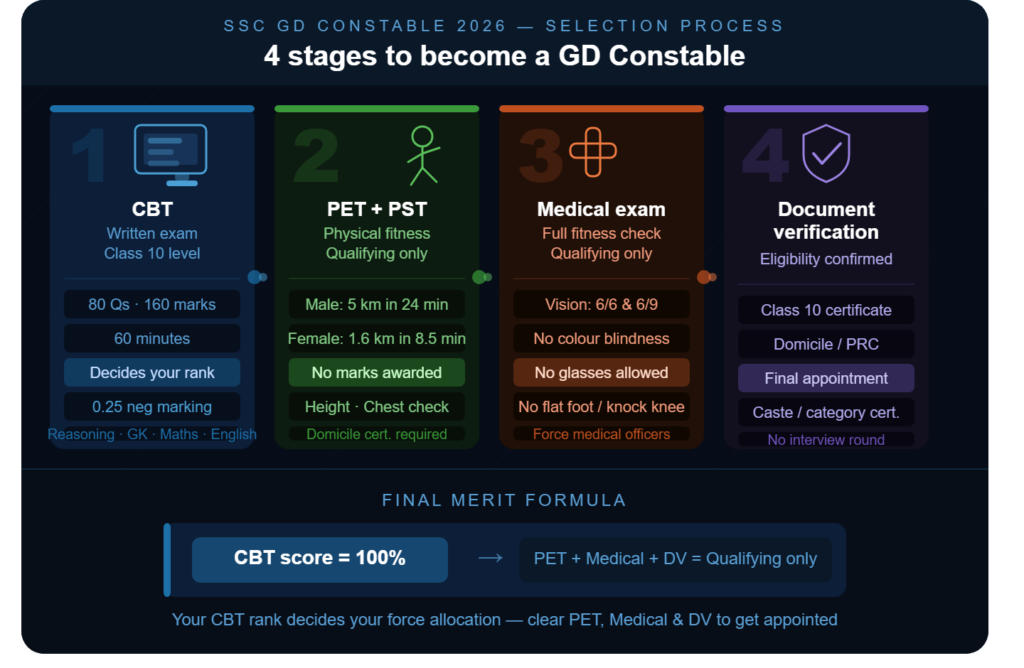
The CBT is an 80-question, 160-mark exam completed in 60 minutes. All questions are objective type (MCQ). The paper is at Class 10 level and available in Hindi, English, and regional languages.
| Section | Subject | Questions | Marks |
| Section 1 | General Intelligence & Reasoning | 20 | 40 |
| Section 2 | General Knowledge & General Awareness | 20 | 40 |
| Section 3 | Elementary Mathematics | 20 | 40 |
| Section 4 | English / Hindi Language | 20 | 40 |
| Total | 80 | 160 |
The PET tests basic physical fitness through a running test. It is qualifying — no marks awarded.
| Test | Male Candidates | Female Candidates |
| 5 km Run | Within 24 minutes | — |
| 1.6 km Run | — | Within 8.5 minutes |
| Category | Height (Male) | Height (Female) | Chest (Male) |
| General / OBC / SC | 170 cm | 157 cm | 80 cm (expanded: 85 cm) |
| ST / Hill Region Candidates | 162.5 cm | 150 cm | 76 cm (expanded: 81 cm) |
| Component | Details |
| Pay Level | Level 3 (7th Pay Commission) |
| Basic Pay | Rs. 21,700/month |
| Dearness Allowance (DA) | ~50% of Basic Pay |
| House Rent Allowance (HRA) | Based on posting location |
| Ration Allowance | For CAPFs — additional food allowance |
| Estimated In-Hand Salary | Rs. 23,527 – Rs. 37,000/month |
| After Promotions (Head Constable) | Level 4 — Rs. 25,500 Basic Pay |
SSC GD offers a clear, merit-based promotion ladder within the force. Promotions are based on seniority, departmental exams, and performance.
No. SSC GD recruits both male and female candidates. Female candidates have different PET standards (1.6 km run in 8.5 minutes) and different height requirements (157 cm for General/OBC/SC, 150 cm for ST). Application fee is also exempted for all female candidates.
You can indicate force preferences during application and document verification. However, final force allocation is based on your CBT rank, available vacancies in each force, and your stated preferences. Higher-ranked candidates get more flexibility in force choice.
You are eliminated from that cycle. PET is a mandatory qualifying stage — there is no second attempt in the same recruitment cycle. Your CBT score does not carry over. You will need to reapply in the next SSC GD recruitment.
You can apply every year as long as you meet the age limit for your category. General candidates can apply until age 23, OBC until 26, and SC/ST until 28. Once you cross the upper age limit, you become ineligible.
Disclaimer
This document is an unofficial educational resource created for exam aspirants. All information should be verified on the official recruitment website before applying. Vacancy numbers, age limits, and eligibility criteria are subject to change with each notification.
Visit MakeMyFuture to find your course →
Try different filters or generate dummy data.